Decade Golf and the Mental Game: The Course Management Strategy Used by PGA Tour Pros
Karl Morris, coach to Major Champions in conversation with Scott Fawcett, founder of Decade Golf
Listen to the full episode or read the key takeaways below
Most golfers who want to improve spend their time on the range working on swing mechanics. They book lessons, watch YouTube videos, and invest in new equipment. And yet, round after round, the same mistakes keep appearing — not because their swing is broken, but because they're making poor decisions and failing to manage their own minds when it counts.
This is the conversation I had recently with Scott Fawcett, founder of Decade Golf — one of the most influential course management systems used on the PGA Tour and DP World Tour today. What emerged was a fascinating alignment between what Decade teaches about decision-making on the course and what the Mind Factor teaches about managing what happens between the ears.
What Is Decade Golf?
If you haven't come across Decade Golf before, it's a data-driven course management system built around one simple but profound idea: most golfers lose shots not because of poor ball-striking, but because of poor decisions.
Scott developed Decade by analysing shot dispersion data from every level of the game — from recreational golfers to PGA Tour players — and what he found was striking. The mistakes that cost you shots aren't the heroic ones. They're the predictable, avoidable ones. Three-putts. Bogeys on par fives. Blown up-and-downs from inside 100 yards. Unnecessary doubles.
Tiger Woods understood this intuitively. Scott calls them the "Tiger Five" — the five statistical categories Tiger tracked religiously at the height of his dominance:
- Double bogeys
- Bogeys on par fives
- Three-putts
- Blown short game saves
- Bogeys with a nine-iron or less in hand
Tiger's insight was that if he could keep his combined mistakes across those five categories to an average of one and a half per round, he would win. Not make the cut — win. The discipline wasn't in the heroics. It was in the elimination of the ordinary mistakes most golfers barely notice they're making.
The Real Cost of a Bad Shot
Here's where Decade and the mental game converge in a way that I think every golfer needs to hear.
Scott made a point during our conversation that stopped me in my tracks. When discussing Dustin Johnson's legendary emotional evenness on the course, he recalled DJ saying something in a television booth that sounded almost too simple: "I'm going to hit good shots every day. Am I really going to get that excited? I'm going to hit bad shots every day. Am I really going to get that mad?"
It sounds obvious. But think about what that statement actually means for your game.
The shot that goes in the rough costs you one shot. The emotional reaction that follows — the frustration, the self-criticism, the tightening up on the next tee — that can cost you three or four more. Scott put it bluntly: if you're getting so angry after a bad shot that it affects the next two holes, that's quitting. Nobody wants to think of themselves as a quitter. But the data says that's exactly what's happening.
This is what I call firing the second arrow. The first arrow is the bad shot — that's going to come. It's golf. But whether you fire the second arrow, whether you compound the damage with your reaction, that's entirely within your control. And it's a skill you can train.
Why Expectations Are Destroying Your Putting
One of the most eye-opening parts of our conversation was Scott's breakdown of putting — specifically pace control and why most golfers are working on entirely the wrong thing.
When most golfers have a bad putting round, they immediately go and work on their stroke mechanics and start line. It feels logical. But Scott's data tells a completely different story.
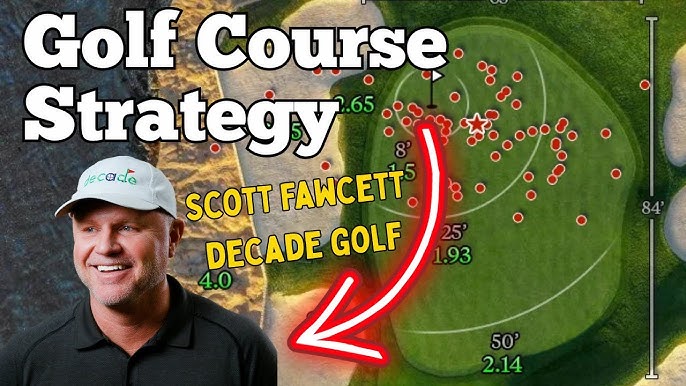
From 20 feet, even the best putters on the PGA Tour have a shot pattern that is three to six times deeper than it is wide. In plain terms: their speed control varies far more than their direction. And on any putt with a meaningful amount of break, your speed doesn't just determine how far the ball travels — it determines the entire arc of the break. Miss your speed by a foot and a perfectly-aimed putt misses low. Miss it the other way and it misses high.
The implication is significant. For most golfers, a modest improvement in pace control would do more for their putting than years of stroke work. Yet almost nobody practises it deliberately.
The mental connection here is just as important. If you understand that an eight-foot putt is roughly a 50-50 proposition — even at tour level — missing it stops being a catastrophe and starts being a coin flip that went the wrong way. You wouldn't berate yourself for calling heads when the coin lands tails. The data frees you from the emotional spiral that a missed short putt can trigger. And as we've seen from the Tiger Five, the three-putts that follow emotional distress cost you far more than the original miss.
Playing One Shape: The Simplicity Principle
Scott has become increasingly direct on the subject of shot shaping — specifically with the driver — and his reasoning is worth understanding.
The best drivers of the golf ball on tour — Dustin Johnson, Brooks Koepka, Sahith Theegala, Keith Mitchell — predominantly work the ball one way. Scott's argument isn't aesthetic. It's mathematical. Double crosses — hitting the ball in the opposite direction to your intended shape — are the single most destructive shot in golf. They send the ball into trouble from which recovery is genuinely difficult, as opposed to a standard miss which usually leaves you in a manageable position.
A driver fitted to fade at optimal spin rates will balloon dramatically if you try to draw it. A draw-fitted driver will balloon if you fade it. The engineering of the club itself pushes you toward one shape. Fighting that costs you.
More broadly, the principle applies to course management across the bag. Picking your shot, committing to it fully, and executing without second-guessing produces better outcomes than endlessly trying to manufacture the perfect shape for every pin position. The decision-making clarity that Decade provides — knowing your actual shot dispersion, choosing realistic targets, accepting that hitting the green is already a great outcome — reduces the mental load that leads to those catastrophic double crosses.
What Decade Does for Your Mind
I asked Scott directly why he believes Decade helps the mental game, not just the strategic game. His answer was illuminating.
The data doesn't just tell you what to do. It tells you what is actually normal. And normal — the real normal, not the TV normal — is far more forgiving than most golfers realise.
Brad Faxon, one of the greatest putters in the history of professional golf, left sixteen percent of his putts short from sixteen to twenty feet. One in six putts from a manageable distance, from arguably the best ever. Knowing that doesn't make you sloppy. It makes you rational. It removes the self-imposed expectation that every putt should drop, every fairway should be hit, every approach should be pin-high.
When your expectations are grounded in reality, the inevitable bad shots lose their emotional charge. You've already factored them in. And when you've already factored them in, you stop firing the second arrow.
As Scott said during our conversation — and this applies equally to Decade and to mind training — the goal isn't to eliminate mistakes. It's to stop letting mistakes compound.
Meditation, Thoughts, and Staying in the Present
Scott is a committed meditator and a student of Sam Harris's Waking Up app. What he described about his relationship with meditation mirrors almost exactly what I teach about the mental game.
For years he approached meditation the way most people do — frustrated that he couldn't stop his thoughts. The breakthrough came when he understood that the point was never to stop thoughts. The point is to change your relationship to them. To notice a thought arising, recognise it for what it is, and let it pass without dwelling on it or reacting to it.
On the golf course, that translates directly. A bad shot will trigger a thought. Maybe frustration, maybe self-criticism, maybe anxiety about the next hole. You cannot prevent that thought from arising. But you can practise not following it — not feeding it, not letting it run into a story about how your game is falling apart.
The sound analogy Scott shared from Sam Harris is one I'll be using myself from now on. When a sound enters your awareness, it doesn't stay. It arrives and it goes. A thought works the same way — but only if you allow it to. Meditation trains that allowing. And the result, on a golf course, is a player who can be two over through five holes and still play the sixth as though it's a fresh start.
Putting It Together
What struck me most about this conversation was how naturally the Decade philosophy and the Mind Factor philosophy fit together. They approach the game from different angles — one from data and strategy, one from psychology and performance — but they arrive at the same place.
Stop trying to be perfect. Understand what realistic looks like. Make better decisions under pressure. Manage your reactions when things go wrong. Keep the mistakes small and the damage contained.
If you're serious about lowering your scores next year, I'd encourage you to explore both. The link for Decade Golf is in the show notes. And if the mental side is where your game is leaking shots, the Mind Caddie app is designed to work on exactly that — with short, practical lessons you can apply before, during, and after your round.
Because at the end of the day, the game isn't won on the range. It's won — or lost — between the ears.
Karl Morris is one of the world's leading performance coaches in golf, working with Major Champions and Ryder Cup captains. The Mind Caddie app brings his mental game coaching to golfers worldwide. Start your 7-day free trial at mindcaddie.golf


.png)