September 17, 2026
How to Remove Doubt From a Tee Shot
That quiet voice that asks "what if?" just before you pull the club back is something every golfer knows. Here's what's actually happening — and the one mental move that dissolves it.

September 17, 2026
That quiet voice that asks "what if?" just before you pull the club back is something every golfer knows. Here's what's actually happening — and the one mental move that dissolves it.
You've been here before. You stand on the tee, pick your target, waggle the club — and then it arrives. A flicker. A whisper. Don't go right. Don't go in the water. Just don't.
In the space of about two seconds, a perfectly ordinary golf shot has turned into a test you're not sure you're going to pass.
Doubt on the tee is one of the most common — and most misunderstood — experiences in golf. Most players try to push through it, talk themselves out of it, or reach for a swing thought to override it. And most of the time, none of it works.
Not because those players lack confidence. But because they're solving the wrong problem.
Doubt isn't a character flaw. It isn't something that only happens to beginners, or to players who haven't practised enough. It's what happens when your mind turns its attention inward — on the outcome, on what could go wrong, on the mechanics of a movement that your body already knows how to make.
There's a useful equation for this. Performance equals potential minus interference. Your potential — your actual ability to strike a golf ball — doesn't change from one shot to the next. What changes is the level of interference. Doubt is interference. It's the gap between what you're capable of and what actually comes out.
"The problem isn't that you can't hit the shot. The problem is what's happening between your ears when you try."
Understanding this shifts everything. Because if doubt is a form of interference rather than a reflection of your ability, the question is no longer how do I get more confident? It's how do I reduce the interference?
The natural instinct when doubt appears is to argue back against it. You tell yourself to think positively. You remind yourself of the good shots you've hit from similar tees. You try to feel confident.
The trouble is that all of this is still happening inside your head, focused on the very thing you're worried about. You haven't changed what your mind is doing — you've just added more noise to the channel.
The harder you try to push doubt out, the more mental energy you're spending on it. Interference doesn't go away because you fight it. It goes away when you give your mind something genuinely better to do.
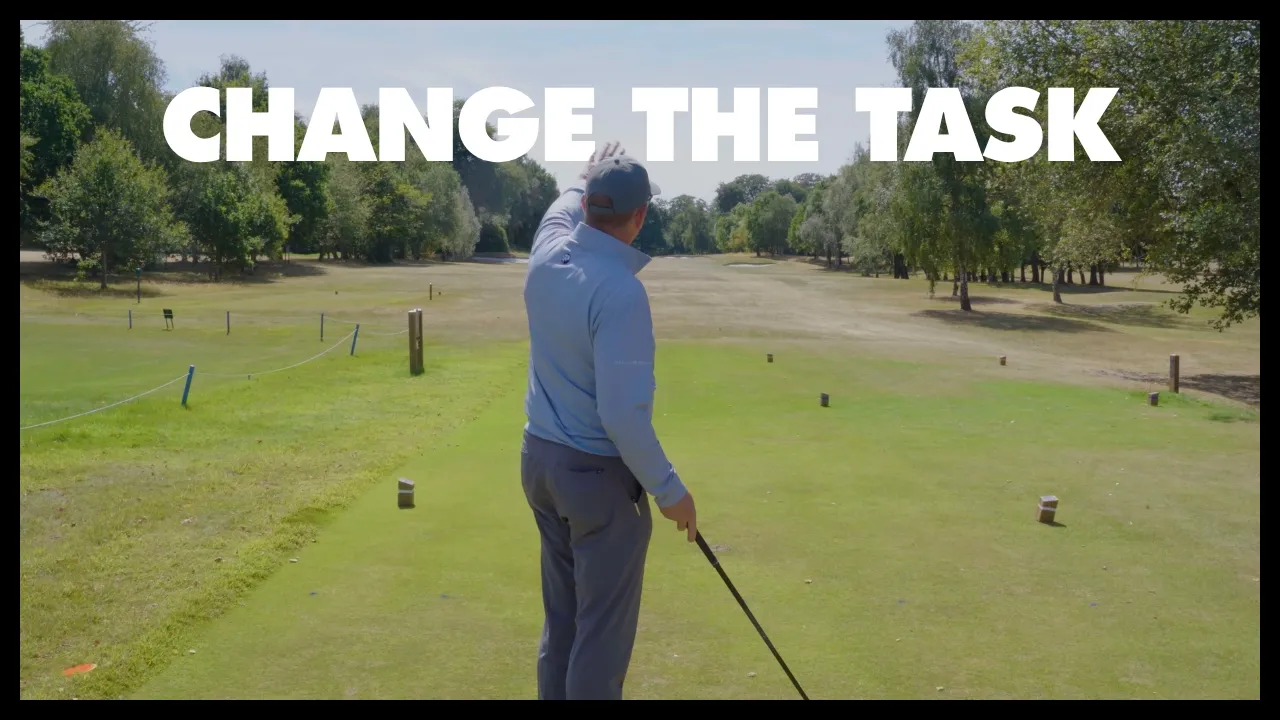
When doubt appears on the tee, don't try to overcome it — change what your mind is actually focused on. Shift your attention away from the outcome and towards a specific, external task. Doubt cannot survive in a mind that is genuinely absorbed in something else.
This is the central insight behind what is sometimes called changing the task — and it's more than a coping strategy. It's a direct application of how attention and performance actually work.
Research into skilled performance consistently shows that an external focus — attention directed outward, at the target, the flight of the ball, a specific landing spot — produces better movement than an internal focus on the mechanics of what your body is doing. When your attention is genuinely external, your subconscious motor system is free to do what it was trained to do.
Doubt, almost by definition, is an internal focus. It pulls your attention towards your body, your swing, the consequences of failure. Changing the task means deliberately redirecting your attention so completely that there is no room for the doubt to continue its work.
This isn't about pretending the doubt isn't there. It isn't about pumping yourself up or repeating affirmations. It's about giving your mind a concrete, absorbing, external job to do — so there is no bandwidth left for the interference.
Here are some ways to do it:
1 Pick the most precise target you can find.Not "the left side of the fairway" — a specific branch on a specific tree. A fence post. A distant flag. The more specific and external your target, the more completely your attention has somewhere real to go. You're not hitting a drive, you're sending the ball to that exact point.
2 See the shot before you hit it.Step back, stand behind the ball, and genuinely see the flight in your mind's eye — the ball leaving the face, the shape of the trajectory, where it lands. This isn't wishful thinking. It's a cognitive task that occupies the visual and spatial parts of your brain in a way that leaves little room for doubt.
3 Commit to a feel word, not a technical thought.Choose one word that describes the quality of swing you want — smooth, free, easy, through — and let that be the only instruction you carry into the swing. One word is not a swing thought. It's an intention. It changes the nature of the task from "execute correctly" to "feel this."
4 Find your target and hold it.As you address the ball, keep your eyes — and your attention — moving back to the target. The moment your focus drifts inward to the club, your grip, or the slope of the fairway, gently bring it back. The target is your job. Everything else can take care of itself.
One of the clearest frameworks for managing the mind on the golf course is built around three words: Intention, Attention, Attitude.
Intention is what you want to happen. It sounds obvious, but many golfers step onto the tee with only a vague sense of where they want to go — and a very vivid sense of where they don't want to end up. Clear intention is specific and positive: ball to that tree, starting left, drifting back. When you know precisely what you intend, you've already begun to crowd out the doubt.
Attention is where your mind actually is during the swing. This is where the task-change does its work. An external focus — on the target, on a feel, on the flight — is the difference between a swing your subconscious can make freely and a swing your conscious mind is trying to supervise at 70 miles per hour.
Attitude is how you're relating to the shot. And this is where acceptance comes in.
Doubt feeds on resistance. The more you need this shot to go well — the more you brace against the possibility that it won't — the stronger the interference becomes.
Acceptance doesn't mean not caring. It means standing on the tee with a clear intention, a genuine external focus, and a quality of mind that isn't clinging to the outcome. You've picked your target. You've seen the flight. You've committed to a feel. Now you let it go.
This is harder than it sounds, which is why it's worth practising — not just on the course, but in the quiet before a round, in the way you rehearse your routine, in the habits you build around how you approach each shot.
"You can't think your way to a clear mind. But you can direct your attention so precisely that doubt has nowhere left to live."
The routine doesn't need to be complex. It needs to be consistent, and it needs to end with your attention somewhere external.
1 Stand behind the ball.Find your target — as precise as possible. See the shot shape. This is your intention.
2 Choose your feel word.One word. Smooth. Free. Through. Whatever quality you want. This is your task for the swing.
3 Step in and find the target again.Before you pull the trigger, look back to your target. Not the hazard, not the rough — the target. Let that be the last thing your eyes and attention settle on.
4 Go. Not when you feel ready. Not when the doubt has passed. When you've completed the routine. The routine is the signal. Trust it.
If doubt shows up during the routine, that's fine. Notice it, reset, and start again. You're not trying to eliminate it. You're training your attention to have somewhere better to go.
The tee shot is where golf most often meets the mind. The driver in your hands, the hole stretching out in front of you, the voices that know every way this could go wrong. What you've just read isn't a cure for that. It's a practice — one that gets easier, and more reliable, the more deliberately you apply it.
You're capable of the shot. The question is how much of that capability you let through.
The Mind Caddie app puts Karl's complete framework into structured audio programmes, daily lessons, and AI coaching. Built for the golfer who knows their game is being held back by what's happening between the ears, not what's happening at the range.
No commitment. Money-back guarantee if you don't see improvement within 3 months.

.png)