April 20, 2026
The Mind Caddie Book — Karl Morris | Golf Mental Game Coaching
Performance coach Karl Morris explains what The Mind Caddie book is, who it's for, and what you'll learn — from the coach behind six Major Champions.

April 20, 2026
Performance coach Karl Morris explains what The Mind Caddie book is, who it's for, and what you'll learn — from the coach behind six Major Champions.

I've spent more than 30 years working with golfers. Beginners trying to break 100 for the first time. Club golfers chasing their handicap. Tour professionals competing at the highest level — Louis Oosthuizen, Darren Clarke, Graeme McDowell, and more than 100 others who've made their living on the tours of the world.
And in all that time, across all those golfers, I keep encountering the same thing.
The feeling that there's a better golfer in there — one who shows up occasionally, unexpectedly, and then just as quickly vanishes. You've felt it. The round where everything clicked. Where the ball went where you were looking, where your mind was quiet and the swing just happened. And then the next week, chasing that feeling and finding nothing but frustration.
That gap — between the golfer you know you can be and the one who turns up most Saturdays — is what The Mind Caddie is about.
I want to be honest with you about something. I qualified as a PGA professional in the early 1990s and spent five years giving conventional swing-based lessons. I was good at it. I could watch a golfer hit the ball beautifully on the range. I could identify technical issues and offer corrections that genuinely improved what I saw in front of me.
But when those same golfers went out on the course, the improvements evaporated. Every time.
It wasn't lost on me that this was my own story too. I'd shown promise as a youngster but every effort to build on it through technical work proved counterproductive. And here I was, repeating the same approach with my students and watching the same frustrating results unfold. Einstein's definition of insanity. Something had to give.
So around 1998 I stepped back from conventional coaching and started looking seriously at the performance side of the game — at why golfers couldn't access on the course what they'd built on the range. It became an obsession. And what I found, through years of research and work with elite players, shaped everything I now believe about golf and about coaching.
Performance is a question of two things: developing your skills, and being able to access them. The industry is very good at the first part. Most coaching, most instruction, most golf content you'll ever consume is about skill development. The second part — accessing those skills under pressure, in competition, when it matters — is almost entirely ignored.
That's the gap The Mind Caddie exists to close.
I want to say this clearly before you read another word: this book will not give you a wider arc or a better downswing sequence. There are plenty of resources out there for that, and many of them are excellent. I have nothing against technical coaching. The quality of your method is without question part of the performance mix.
But it is only part of it. And a part whose value is significantly diminished if you lack the performance skills to call upon it when it counts.
The Mind Caddie is not a swing book. It is not a tips book. It is not a collection of mental tricks to try before you tee off on Saturday. What it is — what I set out to write — is a coaching manual for your relationship with the game. One built on the same principles I use with Major Champions, applied in a way that works just as effectively whether your ambition is the Claret Jug or the Monthly Medal.
The book is built around a concept I call self-mastery — and I want to explain what I mean by that, because it's probably not what you're expecting.
Mastery of the golf ball is an illusion. Not even the very best players in the world have achieved it, and not even they will. Jack Nicklaus holed his tee shot on the 12th at Augusta — and then shanked the next one. Tiger Woods opened a Ryder Cup match with a ball out of bounds. These are the best who ever played, and the game still does what it wants to them. If you're chasing mastery of the golf ball, you will spend your entire golfing life disappointed.
Self-mastery is different. It is the ability to manage yourself — your attention, your reactions, your relationship with the outcome — in a way that gives you the best possible chance of performing. And unlike mastering the golf ball, it is genuinely achievable.
Through the book we cover three areas where self-mastery makes the biggest difference:
Performance. Being in control of ourselves is what allows us to make our best effort on every shot. It is how we give ourselves full access to our skillset — the one we've spent hours building on the range — when we actually need it on the course.
Enjoyment. Self-mastery allows us to play in a spirit that keeps our relationship with the game positive and sustainable. I've seen too many golfers who've lost their love for the game chasing a version of it that doesn't exist. I don't want that for you.
Learning. When we're not overwhelmed by results, by ego, by the story we tell ourselves after every bad shot, we learn faster. Self-mastery opens the pathways that genuine progress runs through.
The chapters cover a wide range of territory — from dealing with tension and pressure, to understanding where your attention needs to be during the swing, to confronting ego and expectation, to the mental preparation that sets you up before a round even starts. Each chapter stands on its own, so you can read them in order or pick out the areas where your game needs most work. But as you work through more of them, you'll start to see how they connect — how they weave together into a coherent picture of what it means to perform.
Three words sit at the centre of everything I teach, and everything in this book: Intention, Attention, Attitude. Get those three right on every shot, and you'll find yourself playing considerably closer to your potential more of the time. That's not a promise built on theory. It's built on three decades of watching it work, from the first tee of Augusta to the first tee of your club medal.
If you've ever played a round of golf that surprised you — where something clicked and you couldn't quite explain why — this book is for you. That experience wasn't luck. It was your natural ability coming through in the absence of the mental noise that usually gets in the way. The Mind Caddie will help you understand what happened, and give you the tools to make it happen more consistently.
If you've had lessons, worked on your swing, hit balls on the range until your hands ached — and then watched it fall apart on the first tee of the competition — this book is for you. The issue is almost never your technique in those moments. It's your ability to access it.
If you're a golfer who loves the game but sometimes can't quite explain why it makes you so frustrated — this book is for you too. Because a healthier relationship with golf isn't just about lower scores. It's about understanding what the game is actually offering you, and choosing to receive it.
I'll be honest: some of what's in this book will challenge you. Some of the ideas will ask you to look at your golf — and yourself — differently. But in my experience, those are the ideas that change things. The quick fixes never do.
You can buy the paperback and eBook here
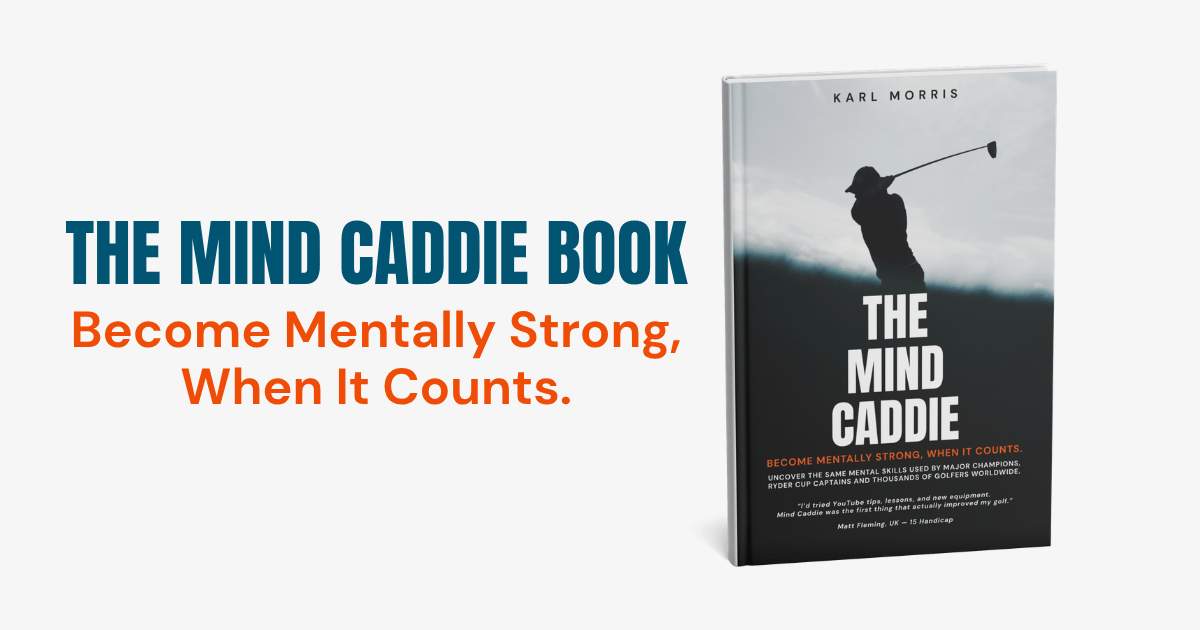
The book is the foundation. But I also wanted to give golfers a way to take these ideas further — and to have access to coaching at the moments when they actually need it most.
That's what the Mind Caddie app is. It brings the coaching philosophy in this book to life through audio lessons, structured programmes, and — most recently — a direct conversation with me through Karl AI. You can tell me you've got a competition on Saturday and you can't stop overthinking. Tell me you've lost your way on the greens. Tell me you know you're capable of better but you can't seem to get out of your own way.
That's what I'm there for. That's what this book is for. That's what 30 years of coaching has been building towards.
You can start with a free trial of the Mind Caddie app and experience the coaching alongside the book. The two are designed to work together — the book gives you the framework, the app gives you the conversation.
Because in the end, the better golfer is already in there. The Mind Caddie is simply the way to let them out more often.
Karl Morris
Performance coach to six Major Champions
The Mind Caddie app puts Karl's complete framework into structured audio programmes, daily lessons, and AI coaching. Built for the golfer who knows their game is being held back by what's happening between the ears, not what's happening at the range.
No commitment. Money-back guarantee if you don't see improvement within 3 months.

.png)