September 14, 2026
The Real Reason You Can't Take Your Range Game to the Course
Golf coach Karl Morris explains why range form doesn't transfer to the golf course and how to train in a way that actually shows up in your score.

September 14, 2026
Golf coach Karl Morris explains why range form doesn't transfer to the golf course and how to train in a way that actually shows up in your score.
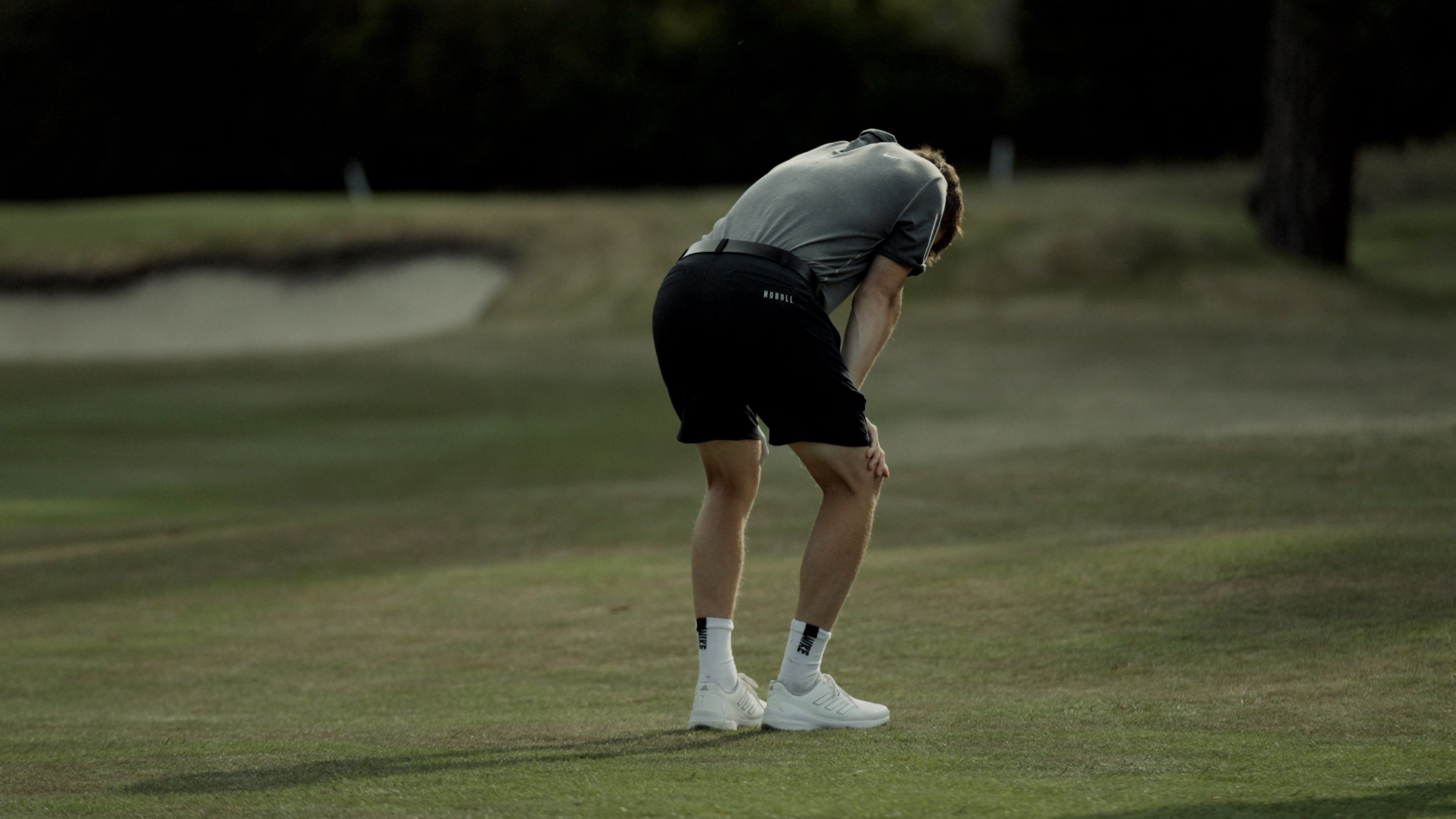
You know the feeling. An hour on the range, flushing iron after iron, drives splitting the fairway in your mind's eye. You leave feeling like a different golfer. Then you get to the first tee on Saturday, and that same swing — the one that felt so reliable an hour ago — seems to have gone missing.
If you've lived this cycle more times than you'd like to admit, I want to tell you something reassuring: it isn't because you lack ability, and it isn't because you "can't handle pressure." It's because of a simple, fixable gap between how you're practising and how the game is actually played. Once you understand that gap, you can close it.
Here's the uncomfortable truth about most range sessions: they don't resemble golf at all. You stand in one spot, hitting the same club to the same target, ball after ball, with no consequence for a poor shot because there's always another one waiting on the mat. That's not golf. That's rehearsing a movement in a laboratory with no stakes.
On the course, you get one ball, one shot, from a lie you didn't choose, to a target that changes every time. There's no second serve. The mismatch between how you train and how you actually play is the single biggest reason your range form doesn't show up when it counts.
This isn't a swing problem. It's a transfer problem — and transfer is something you can deliberately train for.
There's a question worth sitting with: does the swing create the shot, or does the shot create the swing? Most golfers assume the former — that you need to manufacture a series of correct positions and the good shot will follow. But there's a strong case for the opposite. When you have a genuinely clear picture of the shot you want to hit, your body organises itself to produce it, in much the same way it organises itself to throw a ball accurately without you consciously thinking about your arm angle.
This matters because "what's wrong with my swing?" is a question with no clean answer — it sends you chasing positions forever. "What's wrong with my shots?" is a much more useful question, because it points you towards a solution: get clearer on the shot you're trying to hit, and let your body find its own way there.
Most golfers, at every level, practise in blocks — ten balls with the wedge, ten with the 9-iron, ten with the 7-iron, working methodically through the bag. It feels productive. It feels like progress. And it teaches you almost nothing about playing golf.
Block practice lets your body settle into a groove: same club, same target, same swing, repeated until it feels automatic. The course will never once ask you to do that. It'll ask for a punch 7-iron from a downslope, then a full wedge from thick rough, then a low draw around a tree — constantly changing, with real consequence attached to the outcome.
If you want your range time to actually transfer, mix your clubs and targets the way the course will. Play a random shot to a random target, then a completely different one, the way you would moving from hole to hole. It's less soothing than block practice. It's also far closer to the game you're trying to get better at.
Here's a simple but powerful shift: hit one ball to a target, then move on — rather than three or five balls at the same target in a row. If you've got three attempts at the same shot, how much genuine attention are you paying to the first one? Not much, because there's no real cost to missing it.
Playing one ball at a time recreates something the range strips away entirely: consequence. It forces full commitment and a proper routine on every single shot, because there's no second chance to fall back on. That's precisely the mental skill the course demands of you, and it's one you can only build by practising it.
.jpg)
The range will always be useful for technical work. But if your goal is a lower score, the course itself is your best practice ground — because it's the only place that can train the qualities that actually determine your score: decision-making, creativity, composure, and the ability to get the ball round when your best stuff isn't there.
A few ways to do this, especially when the course is quiet:
One more shift that helps enormously: give your range or course practice a scoring system, so it starts to feel like something's actually at stake. A point for every fairway found, two points for every green hit in regulation, regardless of proximity to the pin — this alone changes how much attention you bring to each shot, because now there's a number to protect.
The goal isn't the score for its own sake. It's training your attention to stay on the process — find the fairway, then find the green — one shot at a time, in exactly the rhythm the real course will ask of you.
Your range game isn't failing to transfer because something is wrong with you or your swing. It's because conventional range practice and real golf are, in important ways, two different activities — one with no consequence and total predictability, the other with one shot, changing conditions, and a card that doesn't forgive. Close that gap deliberately — mix your practice, commit to one ball at a time, ask better questions about your shots, and use the course itself as training ground — and you'll start finding that the golfer who shows up on the range is finally the same one who shows up on the first tee.
The Mind Caddie app puts Karl's complete framework into structured audio programmes, daily lessons, and AI coaching. Built for the golfer who knows their game is being held back by what's happening between the ears, not what's happening at the range.
No commitment. Money-back guarantee if you don't see improvement within 3 months.